 MIDDLE EAST
- Home
- Applications
- Plastics drying
Application
Plastics: resin dryer dew point
Monitoring the dew point of dry air from desiccant dryers for hygroscopic resins such as PET, nylon and polycarbonate before moulding and extrusion.
Why it matters
Hygroscopic resins such as PET, nylon (PA) and polycarbonate must be dried before moulding or extrusion; moisture left in the pellets causes hydrolysis, splay marks and weak parts.
Desiccant dryers supply dry process air, commonly around −40 °C dew point. Measuring the dew point of that air shows whether the desiccant is regenerating properly and catches problems before they reach production.
What a dew point reading tells you
| Measurement | What it shows | What it does not show |
|---|---|---|
| Dew point of the dry air at the dryer outlet | Whether the desiccant is removing water and regenerating properly | How much moisture is still in the pellets |
| Dew point of the return air from the hopper | How much water the air picks up from the resin; a check on air flow and drying time | The final moisture of the pellets |
| Residual moisture of the pellets (laboratory test) | Whether the resin is ready for moulding against the supplier's limit | Why the dryer is not performing. It is a different test, usually an instrument that weighs a pellet sample, and YORK does not supply it |
Dew point and moisture content
Dryer specifications usually state a dew point, while moisture is sometimes given in ppmv or as mass of water in the air. At atmospheric pressure they convert as follows (Sonntag 1990, frost point over ice):
| Dew point / frost point | Water content | Water per kg of dry air |
|---|---|---|
| −20 °C | about 1,020 ppmv | about 634 mg/kg |
| −30 °C | about 375 ppmv | about 233 mg/kg |
| −40 °C | about 127 ppmv | about 79 mg/kg |
| −50 °C | about 39 ppmv | about 24 mg/kg |
| −60 °C | about 11 ppmv | about 6.6 mg/kg |
For comparison, intake air with an ambient dew point of 25 °C, common on humid Gulf summer days, carries about 20 g of water per kg, roughly 250 times more than air at −40 °C. The dew point calculator converts between the units.
Where to measure
- Dryer outlet (process air to the hopper): the main measurement. Trend it and set an alarm on a rise.
- Around bed changeover: twin-bed and rotary dryers switch between desiccant beds. A short rise in dew point at each changeover is normal; a rise that does not recover points to a regeneration problem such as a heater fault, a stuck valve or worn desiccant.
- Return air from the hopper: wetter than the outlet air, and useful for checking air flow and residence time.
- Central drying systems: one fixed instrument on the main dry-air line, and a portable meter to check individual hoppers or dryers in turn.
Sampling and installation
- Process air leaving the dryer and heater can be hot. Take the sample from the dry-air line and let it cool to near ambient temperature in a short metal line before it reaches the sensor.
- Use stainless steel or other metal tubing. Plastic tubing lets moisture permeate in and makes low dew point readings slow and too high.
- Resin dust and fines travel with the air. Fit a filter ahead of the sensor and check it during routine maintenance.
- Dryer air runs at low pressure, well within the 4 barg limit of YORK dew point instruments. A small, steady sample flow vented to atmosphere is enough.
- Mount fixed instruments away from heater outlets and direct sunlight, and connect them to the dryer control or plant monitoring system so that a rise in dew point is noticed.
Questions we are asked
What dew point should a resin dryer reach?
The resin supplier's datasheet sets the drying temperature, drying time and target moisture. Desiccant dryers commonly deliver dry air at around −40 °C dew point, but drier air does not make up for a drying time that is too short or a temperature that is too low. An instrument that reads well below the target, down to −110 °C frost point, leaves margin for trending.
Does a dew point instrument measure the moisture in the pellets?
No. It measures the drying air. Residual moisture in the pellets is checked with a separate moisture test on a resin sample. The two complement each other: the dew point shows that the dryer is working, and the pellet test confirms that the resin is ready.
Fixed or portable?
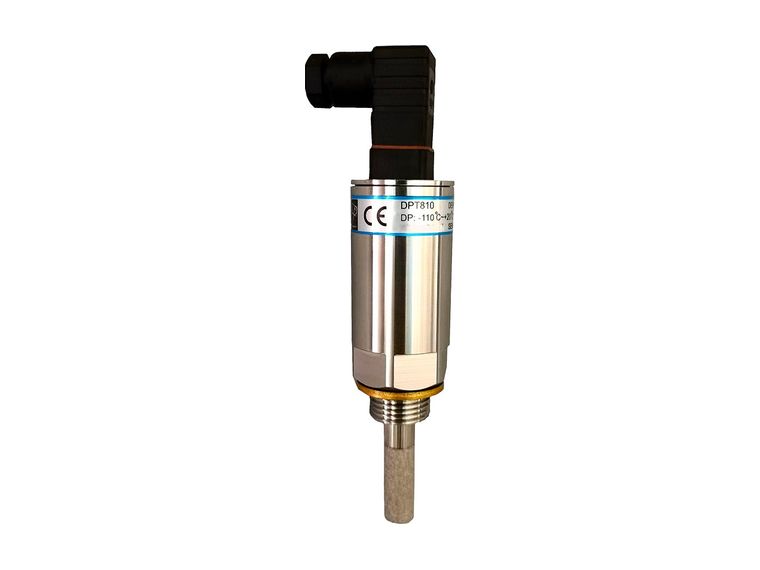
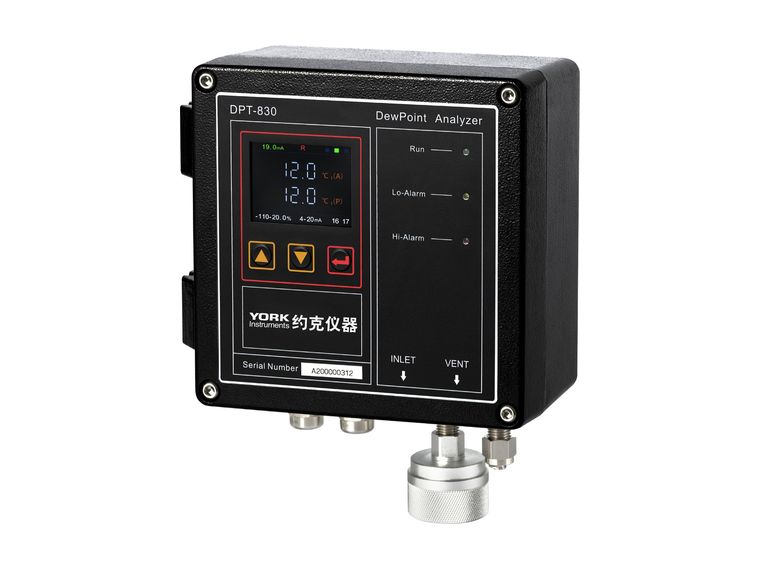
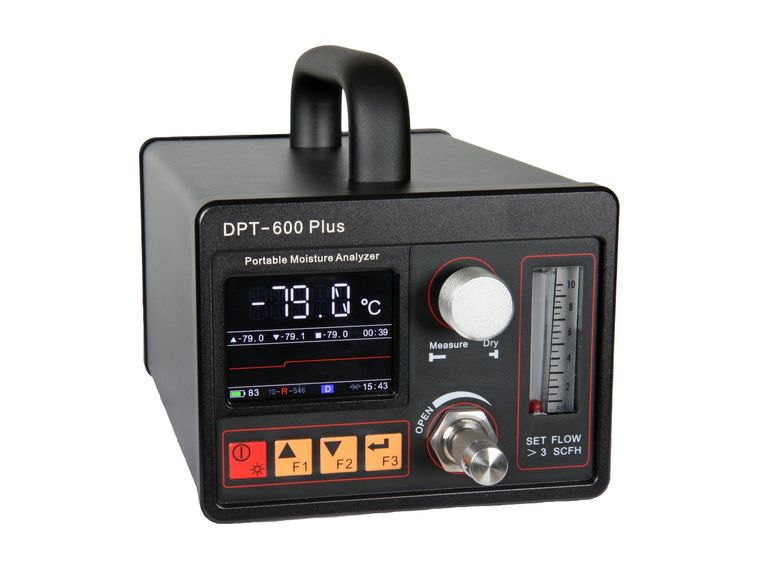
Fixed DPT810 transmitters or DPT830 analyzers with alarm relays suit dryers that run continuously on critical lines. A portable DPT-600 Plus suits plants with many small dryers, for routine rounds and troubleshooting. Many plants use both.
Suggested YORK instruments
- Fixed dew point monitoringDPT810 →
- In-line analyzer with alarm relaysDPT830 →
- Portable checks across dryersDPT-600 Plus →
Discuss your application
Tell us the gas, pressure, sample point and the limit you need to meet, and we will propose instruments and a sample system.