 MIDDLE EAST
- Home
- Applications
- Weather stations
Application
Meteorology and weather stations
Humidity verification for automatic weather stations and airport observing systems in Gulf heat, dust and coastal humidity, with a chilled mirror hygrometer as the dew point reference.
Why humidity is hard to keep right in the Gulf
Most automatic weather stations measure relative humidity with a capacitive polymer sensor inside a radiation screen. In the Gulf these sensors work through summer air above 45 °C inland, coastal dew points near 30 °C, fine dust, salt air and long periods close to saturation at night. Each of these can shift a sensor slowly, and the drift is not obvious in the data because the readings still look plausible.
A field check against an independent reference is the usual way to find that drift. A chilled mirror hygrometer is suited to this job because it measures dew point from first principles: it cools a mirror until condensation forms and holds it there, and reads the mirror temperature. It does not depend on a sensor material that ages.
How much a small dew point error matters
At high dew points the water vapour pressure changes quickly with temperature, so a small dew point error becomes a noticeable relative humidity error. The table shows the effect of a 0.2 °C dew point error under typical Gulf conditions, calculated with the Sonntag (1990) saturation vapour pressure formula over water.
| Condition | Air temperature | Dew point | Relative humidity | RH change for 0.2 °C dew point error |
|---|---|---|---|---|
| Coastal summer afternoon | 35 °C | 28 °C | 67.2 %RH | ≈ 0.78 %RH |
| Coastal, very humid | 40 °C | 30 °C | 57.5 %RH | ≈ 0.66 %RH |
| Coastal summer night | 30 °C | 26 °C | 79.2 %RH | ≈ 0.94 %RH |
| Inland summer afternoon | 45 °C | 20 °C | 24.4 %RH | ≈ 0.30 %RH |
An air temperature error has a similar size of effect in the opposite direction, so a humidity check should record air temperature and dew point at the same place and time.
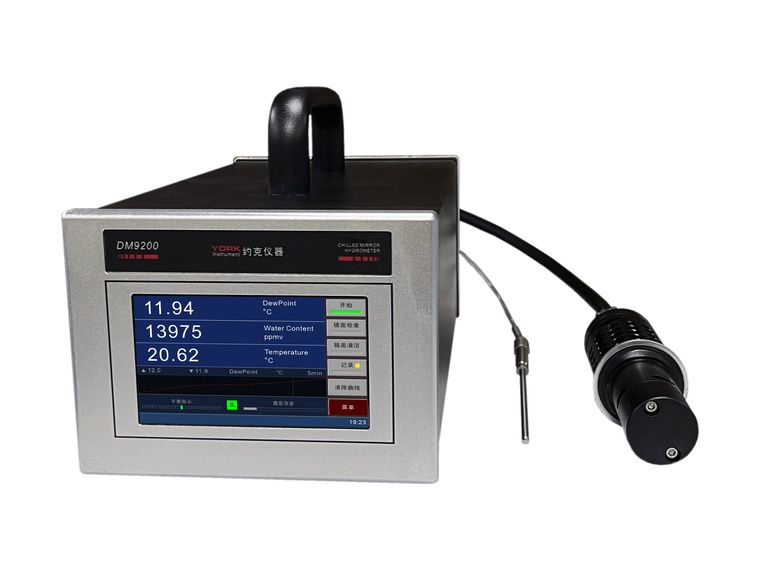
The DM9200 measures dew point with an accuracy of ±0.1 °C. At that level the dew point contribution to the relative humidity error is about half the values in the table, below 0.5 %RH in all four conditions. You can test other combinations with the dew point calculator.
Where a chilled mirror reference is used
- Field verification of station sensors. The reference probe is placed beside the station's sensor, inside or next to the radiation screen, and both are logged together over a stable period.
- Instrument workshops of meteorological services. Sensors removed from the network are compared against the reference in a humidity chamber before they go back into service.
- Airports. Dew point is reported in routine aviation weather reports and is used for fog and visibility forecasting, so the humidity channel of airport observing systems is checked regularly.
- Research and environmental monitoring. Air quality stations, agricultural and solar test sites that need traceable humidity data.
A practical field check
- Choose a stable period. Early morning or a calm overcast period gives steadier readings than a gusty afternoon.
- Co-locate the probes. Put the reference probe at the same height as the station sensor and shade it from direct sun.
- Let the mirror settle. Wait until the chilled mirror reading is steady before recording, and log both instruments for at least several minutes.
- Compare in dew point and RH. Convert both readings to the same quantity using the station's air temperature, and record the difference with the time and conditions.
- Act on the result. Adjust or replace the sensor when the difference exceeds the tolerance your network or the instrument's specification allows.
The measurement of humidity, sensor exposure and field checks are described in detail in the WMO Guide to Instruments and Methods of Observation (WMO-No. 8), Volume I, chapter on humidity measurement.
Questions we are asked
Why use a chilled mirror instead of a second capacitive sensor?
A second capacitive sensor can drift in the same way as the one being checked. A chilled mirror measures dew point directly from the temperature at which condensation forms, so it gives an independent reference.
Can the chilled mirror stay at the station permanently?
It can, but most networks use it as a transfer reference: one instrument travels between stations and the workshop, and is itself calibrated on a regular schedule.
Does dust affect a chilled mirror?
Contamination on the mirror can shift the reading, so the mirror is inspected and cleaned as part of each check. In dusty sites a protective filter on the probe helps.
Suggested YORK instruments
- Where to check humidity in a station networkMap →
- Field reference for high dew points, ±0.1 °CDM9200 →
- How a chilled mirror measures dew pointPrinciple →
- Chilled mirror vs metal oxide sensorsComparison →
Discuss your network
Tell us how many stations you run, the sensors you use and how you check them today, and we will propose a reference instrument and a field check routine.