 MIDDLE EAST
- Home
- Applications
- Process & utilities
Application
Process oxygen monitoring and inerting
Oxygen analyzers for nitrogen blanketing, inerting and process control: trace and percent O₂, in-line and portable, with explosion-proof models.
Why it matters
Nitrogen blanketing and inerting keep oxygen below a set limit to prevent fires, explosions and oxidation in tanks, reactors, dryers and transfer lines. The oxygen measurement confirms that the inert atmosphere is maintained.
Depending on the process, the limit may be a few percent or a few ppm, so the analyzer range matters: percent analyzers for inerting and blanketing control, trace analyzers where the specification is in ppm.
Which oxygen measurement for which job
| Task | Typical oxygen level | Analyzer type | YORK option |
|---|---|---|---|
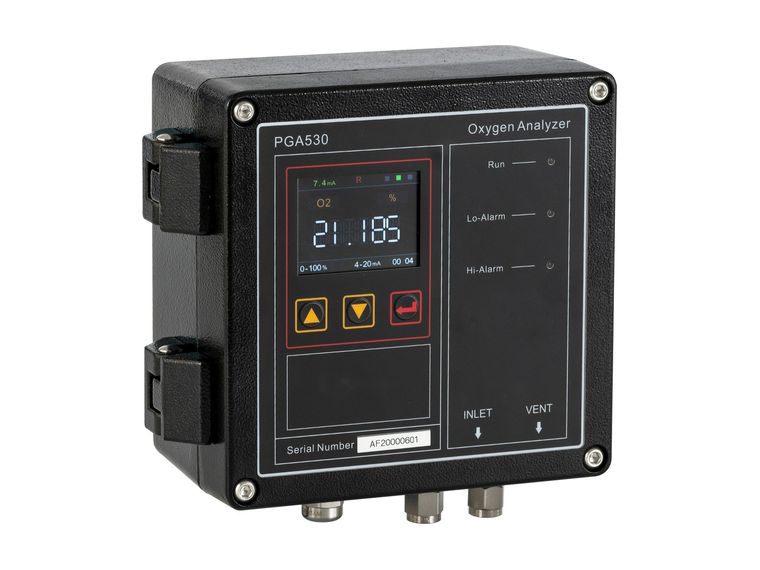
| Blanketing control on tanks, reactors and dryers | Percent range; the limit comes from the process safety study | In-line percent O₂ with alarm relays | PGA530 |
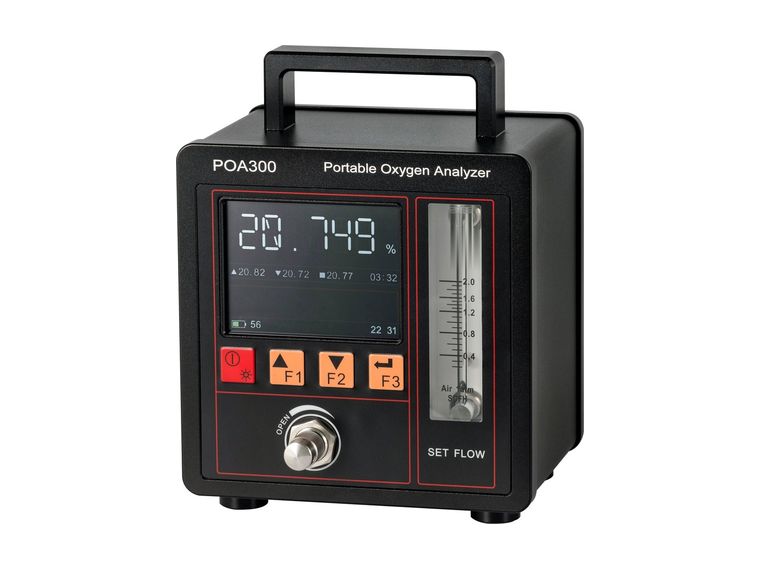
| Purging before start-up or maintenance; checking several points in turn | Percent range | Portable percent O₂ | POA300 |
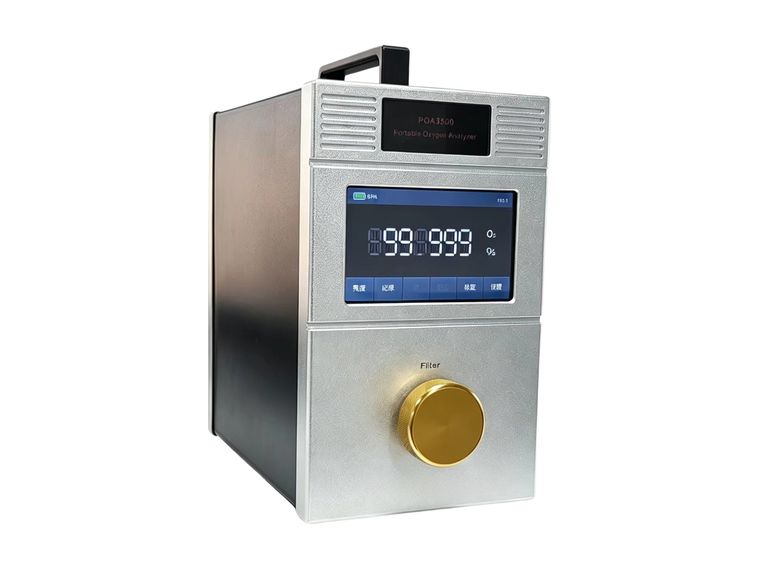
| Inert gas or process gas that contains CO₂ | Percent range | Paramagnetic O₂ | POA3500 |
| Nitrogen purity where the specification is in ppm | ppm range | Trace O₂, in-line or portable | PGA500 / POA200 |
Percent, ppm and purge volumes
Oxygen limits are written both in percent and in ppm: 1% O₂ equals 10,000 ppmv, and 0.1% equals 1,000 ppmv. When a vessel full of air is purged with oxygen-free nitrogen and the gas mixes well, the oxygen falls by a factor of about 2.7 for each vessel volume of nitrogen:
| Target O₂ | In ppmv | Nitrogen needed, well-mixed vessel |
|---|---|---|
| 1% | 10,000 ppmv | about 3.0 vessel volumes |
| 0.5% | 5,000 ppmv | about 3.7 vessel volumes |
| 0.1% | 1,000 ppmv | about 5.3 vessel volumes |
Real vessels have dead zones, internals and nozzles that sweep poorly, so they need more nitrogen than this. The calculation tells you roughly how long a purge will take; the oxygen reading confirms that it is finished. The nitrogen purge calculator works through other targets.
Where the nitrogen specification also limits moisture, dew point and water content convert as follows at atmospheric pressure (Sonntag 1990, frost point over ice): −40 °C is about 127 ppmv, −50 °C about 39 ppmv, −60 °C about 11 ppmv and −70 °C about 2.6 ppmv. The moisture and oxygen unit converter covers other values.
Where to measure
- Nitrogen supply: at the generator outlet or the main header, to confirm purity before the gas reaches users. A rise in oxygen from a membrane or PSA generator points to a fault or to demand above its design flow.
- Vessel headspace or vent line: the measurement that shows the blanket is being maintained. Sample where the gas is least well swept, not next to the nitrogen inlet.
- End of a purge: at the vent, and at more than one point on large vessels, before the vessel is declared inert for the next step.
- Before vessel entry: checking that a vessel has been made safe to enter is a separate task, done with personal gas detectors under the site's permit procedure.
Sampling and installation
- Use stainless steel tubing and leak-tight fittings, and leak-test after installation. Air drawn into a sample line raises the reading, and at ppm level a small leak dominates the result.
- Keep sample lines short and the flow steady; long lines delay the response. The sample line response time tool estimates the delay.
- Remove liquids and dust with a filter ahead of the analyzer.
- Electrochemical sensors are not recommended where the gas contains H₂S, HCl or SO₂. In hydrogen or hydrocarbon backgrounds they work, but sensor life drops to about 12 months, so plan regular replacement.
- Check the analyzer with pure nitrogen as zero gas and a span gas close to the control limit.
- The PGA530 and POA3500 are for safe areas. In a hazardous area, place the analyzer in a safe area and bring the sample to it.
Questions we are asked
What oxygen limit should a nitrogen blanket be kept below?
The limit comes from the process safety study for the substances involved, usually the limiting oxygen concentration with a safety margin. We do not set the limit; we help choose an analyzer whose range and alarm settings fit it.
Why a paramagnetic analyzer when the gas contains CO₂?
A CO₂ background shortens the life of electrochemical oxygen sensors considerably. For gas mixtures that contain CO₂ we recommend the paramagnetic POA3500. It is a portable unit, but it can also run for long periods on mains power as an online analyzer in a safe area.
Can these analyzers be installed in a hazardous area?
The PGA530 and POA3500 are not explosion-protected and belong in a safe area. Certificate details are sent with quotations. Where a project specifies IECEx or ATEX, ask us first; the analyzer can also be installed in a safe area with the sample line brought to it.
Suggested YORK instruments
- Percent O₂, in-linePGA530 →
- Percent O₂, portablePOA300 →
- Paramagnetic percent O₂POA3500 →
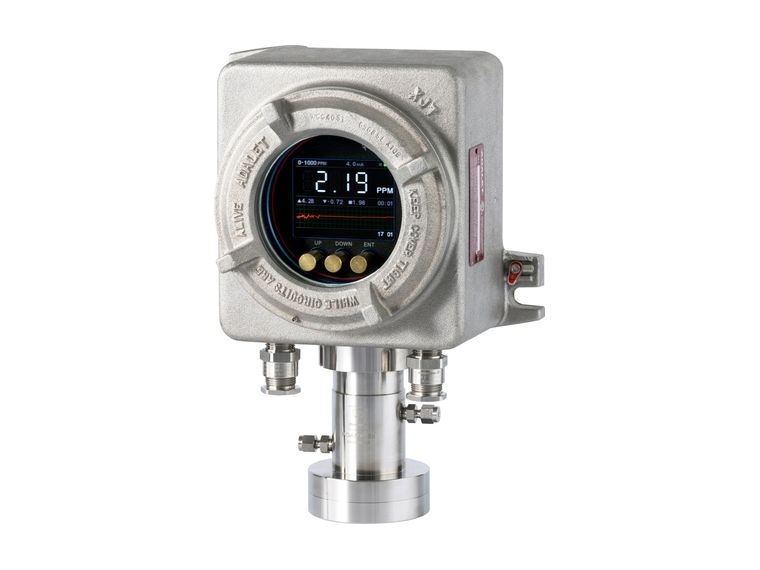
- Trace O₂ in hazardous areasPGA500-EX →
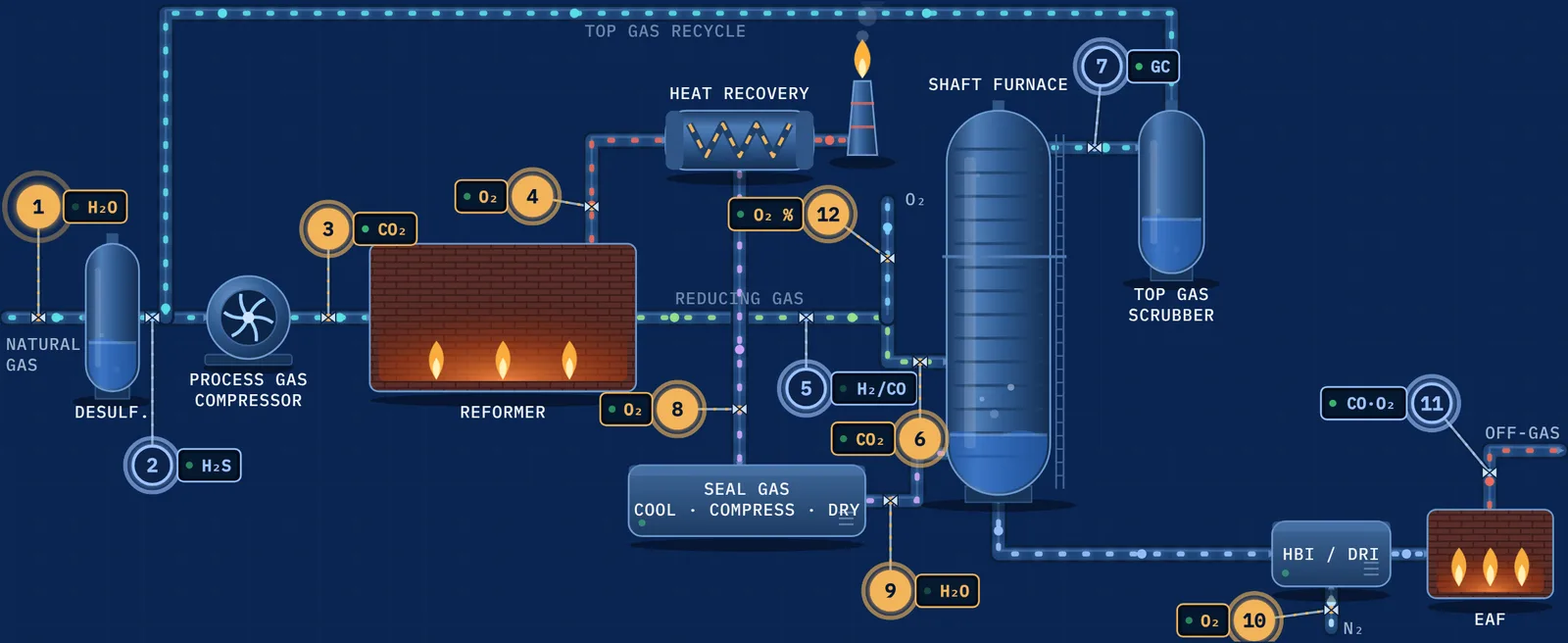
Running a DRI plant? See the animated DRI and EAF measurement-point map.
Discuss your application
Tell us the gas, pressure, sample point and the limit you need to meet, and we will propose instruments and a sample system.