 MIDDLE EAST
- Home
- Applications
- Battery dry rooms
Application
Lithium battery dry rooms and glove boxes
Dew point and oxygen monitoring for lithium-ion battery dry rooms and inert glove boxes: in-line transmitters, portable checks and trace O₂ analyzers.
Why it matters
Lithium-ion cell assembly is carried out in dry rooms because moisture reacts with the electrolyte and degrades cell performance and safety. Dry rooms are commonly held at very low dew points, often in the −40 °C to −60 °C range or drier near the most sensitive steps.
Inert glove boxes used for battery materials, research and other air-sensitive work keep both oxygen and moisture at very low levels, typically around 1 ppm or below. Continuous measurement of both confirms the atmosphere and shows when the purifier needs regeneration.
Fixed dew point sensors in the supply and return air give continuous monitoring and alarms; a portable analyzer is useful to map the room and verify the fixed points.
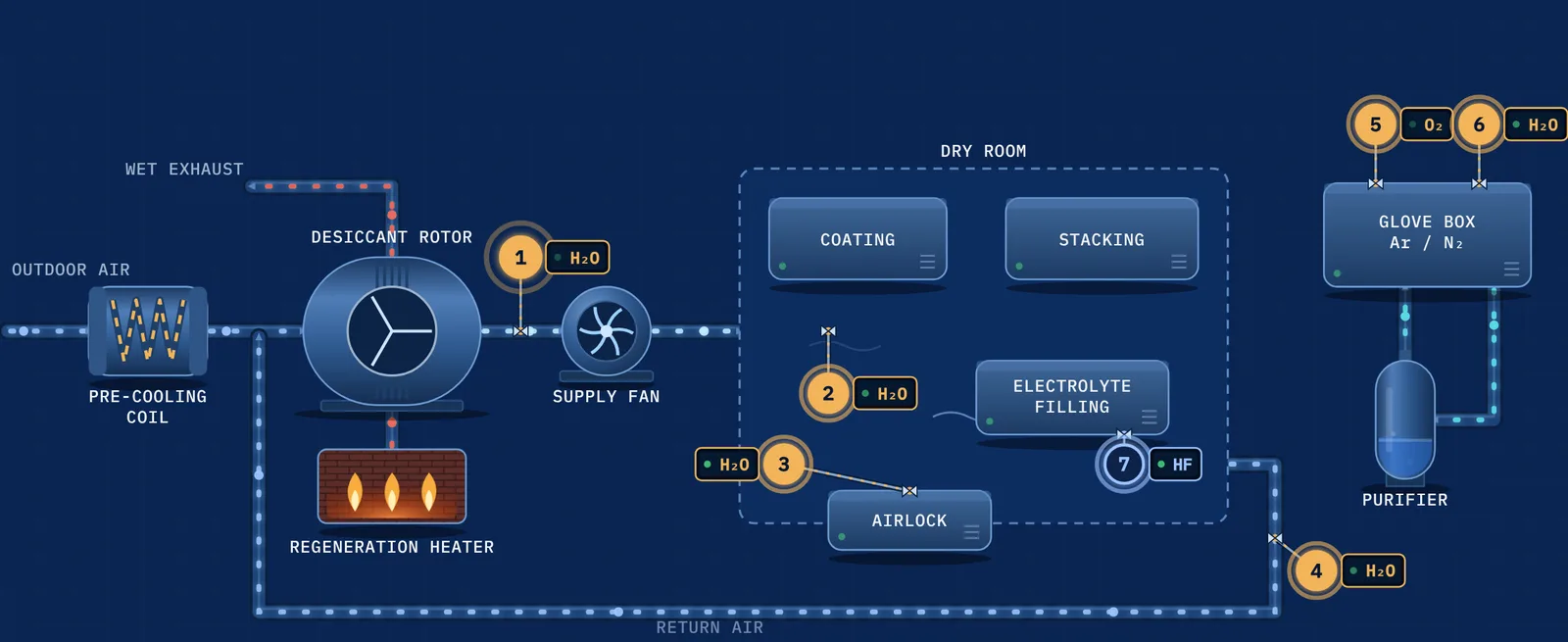
Which measurement for which job
| Task | Typical level | Instrument type | YORK option |
|---|---|---|---|
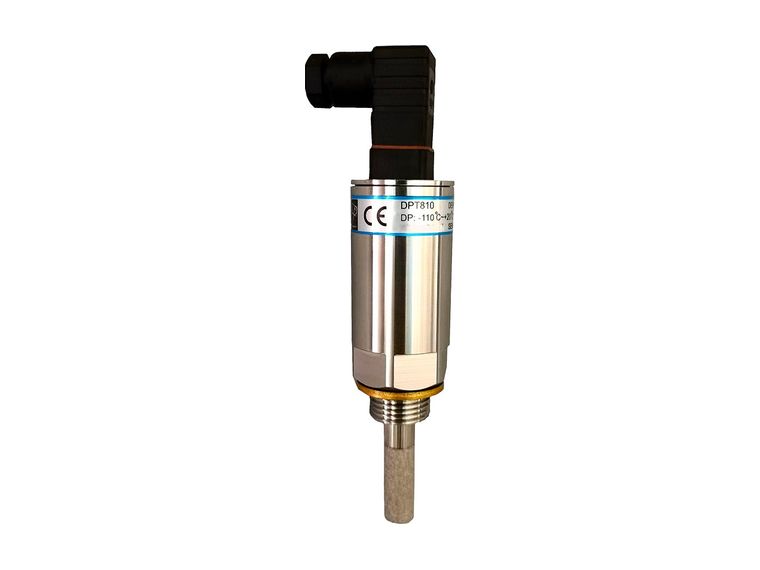
| Continuous dew point in dry room supply and return air, with alarms | Often −40 °C to −60 °C dew point | Fixed dew point transmitter | DPT810 |
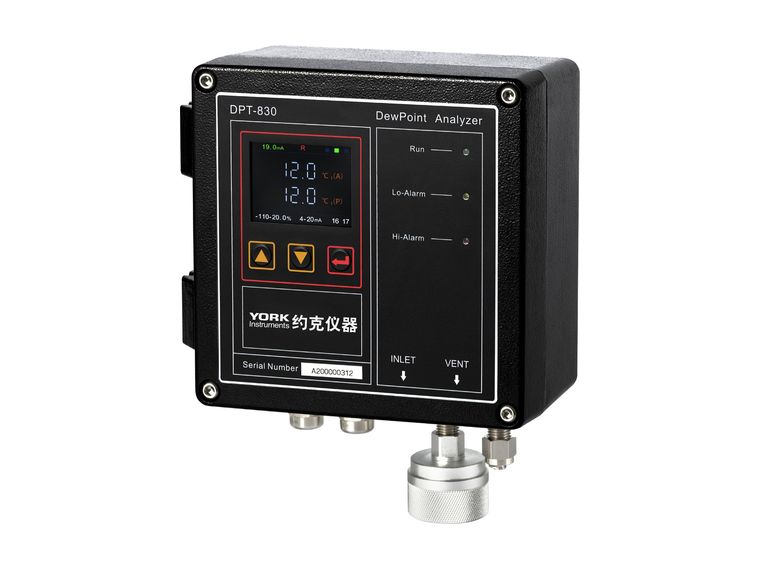
| In-line dew point with display and relay outputs, for example after the dehumidifier | Down to the driest points of the room | In-line dew point analyzer | DPT830 |
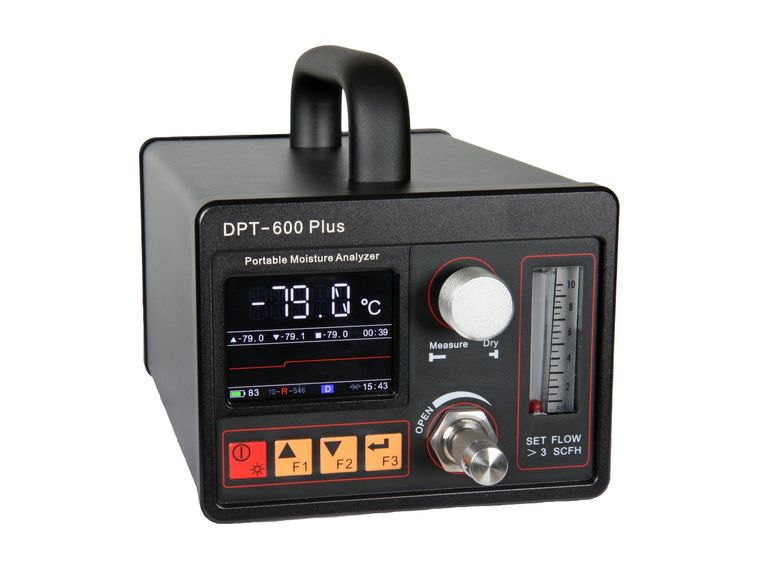
| Mapping the room and checking fixed sensors | Same range as the fixed points | Portable dew point meter | DPT-600 Plus |
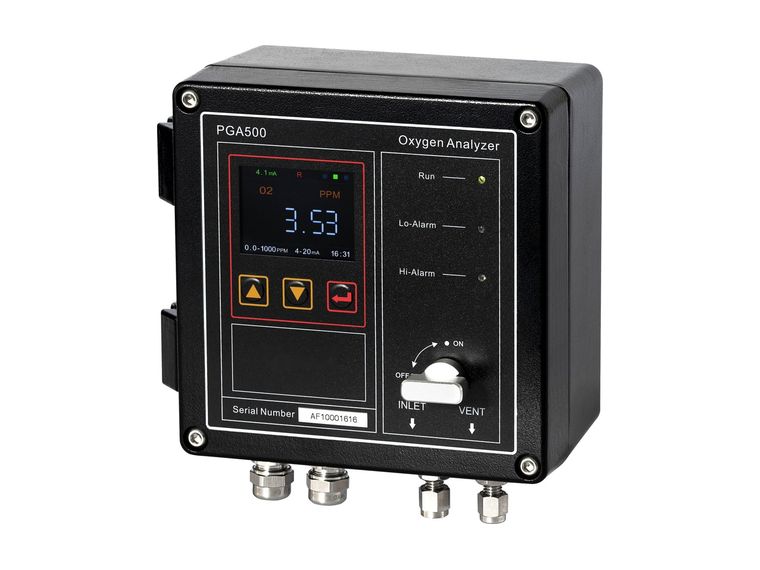
| Oxygen in inert glove boxes | Around 1 ppm or below | Trace O₂, in-line or portable | PGA500 / POA200 |
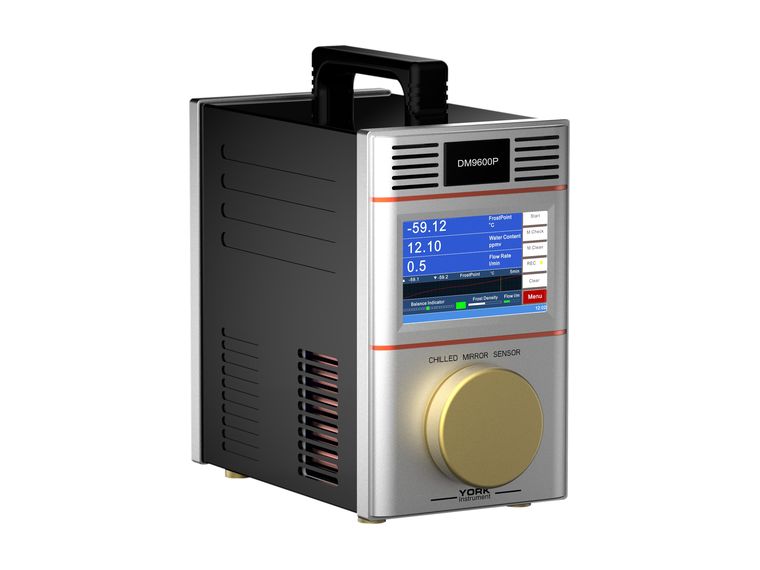
| Reference checks of dew point instruments | Down to −60 °C frost point (portable) or −90 °C (laboratory) | Chilled mirror hygrometer | DM9600P / DM9900 |
Dew point and ppmv
Dry room specifications are usually written as a dew point, while glove box moisture is usually given in ppm. At atmospheric pressure the two convert as follows (Sonntag 1990, frost point over ice, 1013.25 hPa):
| Frost point | Water content |
|---|---|
| −30 °C | about 375 ppmv |
| −40 °C | about 127 ppmv |
| −50 °C | about 39 ppmv |
| −60 °C | about 11 ppmv |
| −70 °C | about 2.6 ppmv |
| about −76 °C | 1 ppmv |
Each 10 °C step in dew point changes the water content by a factor of three to four, so a room that drifts from −50 °C to −40 °C holds more than three times as much moisture. A glove box held at 1 ppm moisture is at about −76 °C frost point, which is drier than most dry rooms and below the range of a −60 °C portable reference. The moisture and oxygen unit converter covers other values.
On a humid Gulf summer day, outdoor air at a dew point of 25–28 °C carries 20–24 g of water per kg of dry air, roughly 250 to 300 times more than dry room air at −40 °C (about 79 mg/kg). Almost all of that water has to be removed from the make-up air before it reaches the room, so dry rooms in the region depend heavily on the desiccant dehumidifier, and a dew point sensor at its outlet is the first place a problem shows.
Where to measure
- Dehumidifier outlet / supply air: shows what the desiccant dehumidifier delivers. A rising dew point here points to the dehumidifier, not to the room.
- Room return air: shows the condition of the room as a whole, including moisture from people, materials and air coming in through doors.
- At the most sensitive steps: near electrolyte filling and other moisture-sensitive operations, at working height, where the specification is often tightest.
- Airlocks and pass-throughs: a portable meter shows how long the room needs to recover after doors open and materials come in.
- Glove box gas: oxygen and moisture in the box atmosphere, ideally sampled from the circulation loop. A steady rise in either reading is the usual sign that the purifier needs regeneration.
The battery dry room measurement-point map shows these points on a process diagram.
Sampling and installation
- Use stainless steel tubing and leak-tight fittings, and leak-test after installation. At −60 °C dew point or 1 ppm oxygen, a small leak or a plastic tube lets in enough room air to dominate the reading.
- Keep sample lines short and the flow steady. Dry-down after installation or after a line has been opened can take hours at very low dew points; the sample line response time tool estimates the transport delay.
- Dry room air and glove box gas are close to atmospheric pressure. YORK dew point instruments accept sample pressure up to 4 barg, so higher-pressure sources such as gas supply lines need a pressure reducer before the instrument.
- Return the sample gas from a glove box to the box or to its exhaust, as the site procedure requires, so the analyzer does not become a path for moisture or oxygen back into the box.
- Check fixed dew point sensors on a schedule with a portable meter or chilled mirror reference at the same point, and check oxygen analyzers with a zero gas and a span gas suited to the range.
Questions we are asked
What dew point should a battery dry room be held at?
The limit comes from the cell maker's process specification. Rooms are commonly held at −40 °C to −60 °C dew point, or drier near the most sensitive steps. We do not set the limit; we help choose instruments whose range and alarm settings fit it.
Can one analyzer measure both oxygen and moisture in a glove box?
Oxygen and moisture are measured by separate instruments: a PGA500 or POA200 for trace oxygen and a DPT810 or DPT830 for dew point. Both can be fed from the same sample point when the sample line is leak-tight.
How do I check that fixed dew point sensors are reading correctly?
Measure at the same point with a DPT-600 Plus portable meter, or with a DM9600P chilled mirror hygrometer down to −60 °C frost point. For drier glove box levels, a DM9900 laboratory chilled mirror reaches −90 °C frost point.
Can YORK measure the moisture in electrolyte or electrode materials?
No. Moisture in liquids and powders is measured in the laboratory, usually by Karl Fischer titration, and YORK does not supply that equipment. YORK instruments measure moisture and oxygen in the air and gas around the product: dry room air, glove box atmospheres and the gas supplies that feed them.
Suggested YORK instruments
- Glove box measurement pointsMap →
- Fixed dew point monitoring and alarmsDPT810 →
- In-line analyzer with relay outputsDPT830 →
- Room mapping and verificationDPT-600 Plus →
- Trace oxygen in glove boxesPGA500 →
- Reference checksDM9600P →
- Portable trace oxygen checksPOA200 →
- Reference below −60 °C frost pointDM9900 →
Where exactly are the points? See the animated battery dry room measurement-point map.
Discuss your application
Tell us the gas, pressure, sample point and the limit you need to meet, and we will propose instruments and a sample system.