 MIDDLE EAST
- Home
- Applications
- LNG molecular sieve dehydration
Application
LNG pretreatment: molecular sieve dehydration and trace moisture
Monitoring trace moisture at the molecular sieve dryers ahead of LNG liquefaction, detecting breakthrough and checking regenerated beds, with YORK dew point analyzers, chilled mirror references, sample systems and analyzer panels.
Why it matters
Liquefaction runs at about −160 °C, so water must be removed before the gas reaches the cold box. Molecular sieve beds dry the feed gas to trace levels: one or more beds adsorb while another is regenerated with hot gas and then cooled. If water breaks through, it freezes in the main cryogenic heat exchanger and can plug it. A trace moisture analyzer at the dryer outlet shows breakthrough as it starts and confirms that a regenerated bed is back in specification.
Typical values
| Point | Typical value | Note |
|---|---|---|
| Molecular sieve dryer outlet / cold box inlet | 0.1 ppmv water or lower, about −90 °C frost point at 1 atm | The exact limit is set by the process licensor |
| Nitrogen rejection unit feed | Dried to trace levels | Same deep drying as the cold box feed |
| Acid gas removal outlet (for reference) | About 50 ppmv CO₂ | Needs a low-range CO₂ analyzer, supplied as part of an integrated system |
Values are typical figures from published specifications and technical literature; the licensor and plant specification govern. See all points in the LNG pretreatment measurement map.
Where to measure
| # | Point | What is checked | YORK solution |
|---|---|---|---|
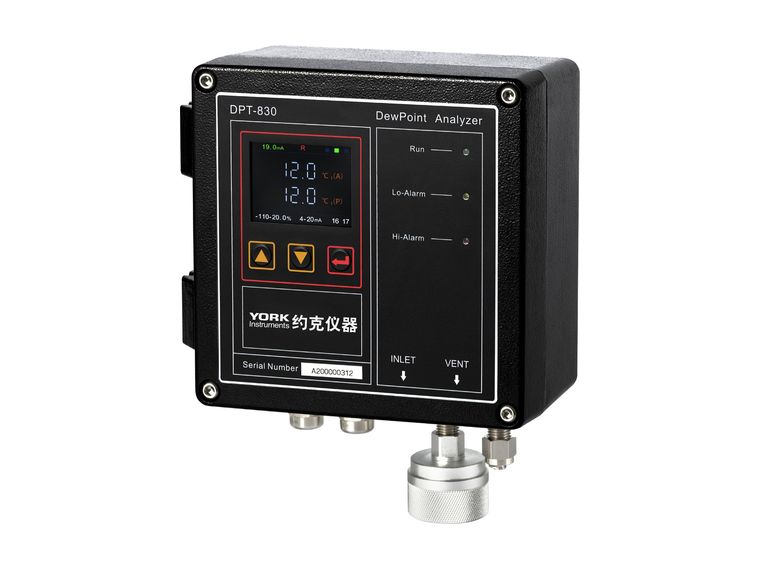
| 1 | Outlet of each bed, or one analyzer switched between beds | Breakthrough; which bed is affected | DPT830 on a sample switching panel |
| 2 | Common dryer outlet, after the dust filter, before the cold box | Trace water entering the cryogenic section | DPT830 in a analyzer shelter or panel |
| 3 | Mid-bed sample point (optional) | Early warning of the water front | DPT830 |
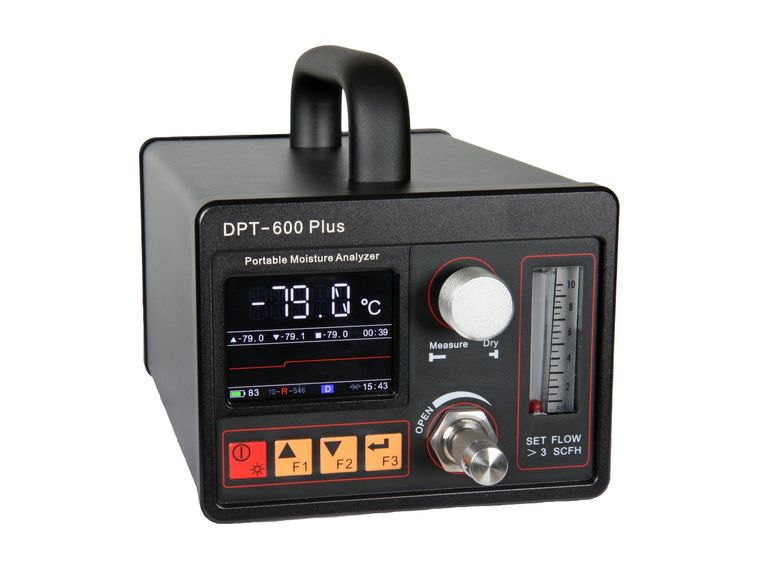
| 4 | Regenerated bed, before it returns to service | Outlet moisture during cooling and the first minutes on line | DPT-600 Plus portable |
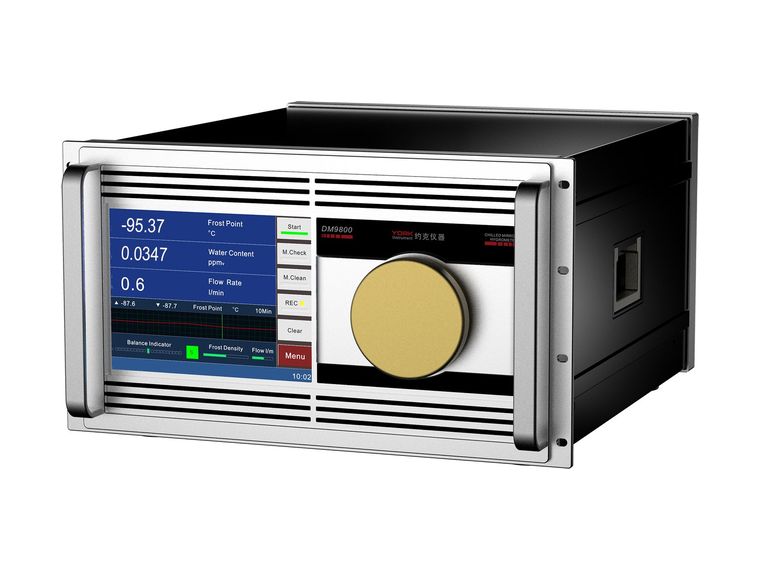
| 5 | Analyzer verification and troubleshooting | Reference dew point | DM9900 chilled mirror, to −90 °C frost point |
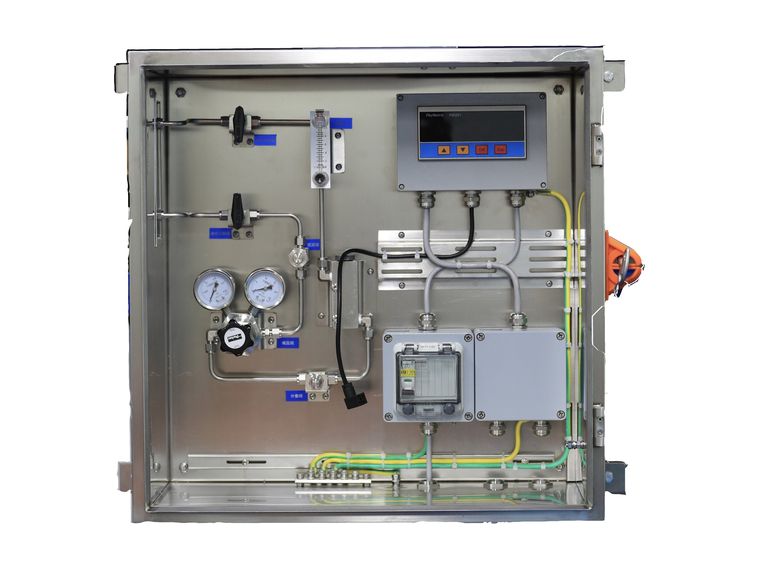
| 6 | Every sample point | Pressure reduction, filtration, bypass flow | DPSS-61XX sample conditioning system |
Sample systems and analyzer shelters
At 0.1 ppmv, the sample system decides whether the reading represents the process. YORK builds sample conditioning systems, analyzer panels and analyzer shelters around its moisture, oxygen and CO₂ analyzers at its factory in Chengdu, to the project specification. A typical moisture system includes a probe and isolation valve, pressure reduction, a filter for sieve dust and liquids, a fast bypass loop, heat tracing where needed, and sample switching where several beds share one analyzer. Pretreatment and liquefaction are classified areas, so analyzers sit in a certified analyzer shelter or use hazardous-area versions; certificates are provided per model with quotation.
Taking reliable readings
- Use short electropolished stainless steel tubing and as few fittings as possible; moisture released by tubing walls dominates at trace level.
- Keep the sample flowing continuously so the line does not have to dry down again after each stop.
- YORK dew point instruments accept up to 4 barg. Reduce the pressure at the sample point, measure near atmospheric pressure and convert with the dew point calculator.
- When beds share one analyzer, set the switching interval to allow for dry-down after each change; the sample line response time calculator gives the transport delay.
- Plot the time to breakthrough for each bed over months to see how fast the sieve is ageing.
Questions we are asked
How dry must gas be after LNG molecular sieve dehydration?
Typically about 0.1 ppmv water or lower, roughly −90 °C frost point at atmospheric pressure. The exact limit is set by the process licensor for the plant.
How is molecular sieve breakthrough detected?
With a trace moisture analyzer at each bed outlet or at the common outlet. The outlet moisture stays flat at trace level, then rises, slowly at first and then quickly. A mid-bed sample point gives earlier warning.
How do you check a regenerated molecular sieve bed?
Measure the outlet moisture while the bed is cooled and during the first period back on line, with the in-line analyzer or a portable DPT-600 Plus. The reading should return to trace level before the bed takes the full load.
Which YORK products are used for LNG dehydration?
The DPT830 in-line trace moisture analyzer, to −110 °C frost point, the DPT-600 Plus portable meter, the DM9900 chilled mirror reference, and DPSS-61XX sample conditioning systems, sample switching panels and analyzer shelters built by YORK.
Suggested YORK instruments
- Dryer outlet and bed outlets, in-lineDPT830 →
- Regenerated bed checks, troubleshootingDPT-600 Plus →
- Reference dew pointDM9900 →
- Sample conditioningDPSS-61XX →
- Panels and sheltersAnalyzer panels →
Detail on bed loading and switching: molecular sieve dryer breakthrough: how to detect it. Sizing a dryer? Use the desiccant dryer water load calculator and the natural gas water content calculator.
Monitoring molecular sieve dryers?
Tell us the number of beds, the line pressure, the moisture limit and the area classification, and we will propose analyzers, sample systems and a panel or shelter.