 MIDDLE EAST
- Home
- Applications
- Natural gas & LNG
Application
Natural gas and LNG: water dew point
Water dew point and trace moisture in natural gas processing, pipelines and LNG pre-treatment, with YORK in-line, portable and explosion-proof analyzers.
Why it matters
Water in natural gas can form hydrates, cause corrosion where free water condenses, and reduce heating value. Gas processing plants therefore dry the gas, and pipelines and sales contracts set a maximum water content or water dew point at a stated pressure.
Dew point depends on pressure: the same gas has a higher dew point at line pressure than at atmospheric pressure. When you compare a reading with a specification, check that both refer to the same pressure, and convert where needed.
Molecular sieve dehydration ahead of LNG liquefaction needs very dry gas, so the measurement at the dryer outlet is a trace moisture measurement at very low dew points.
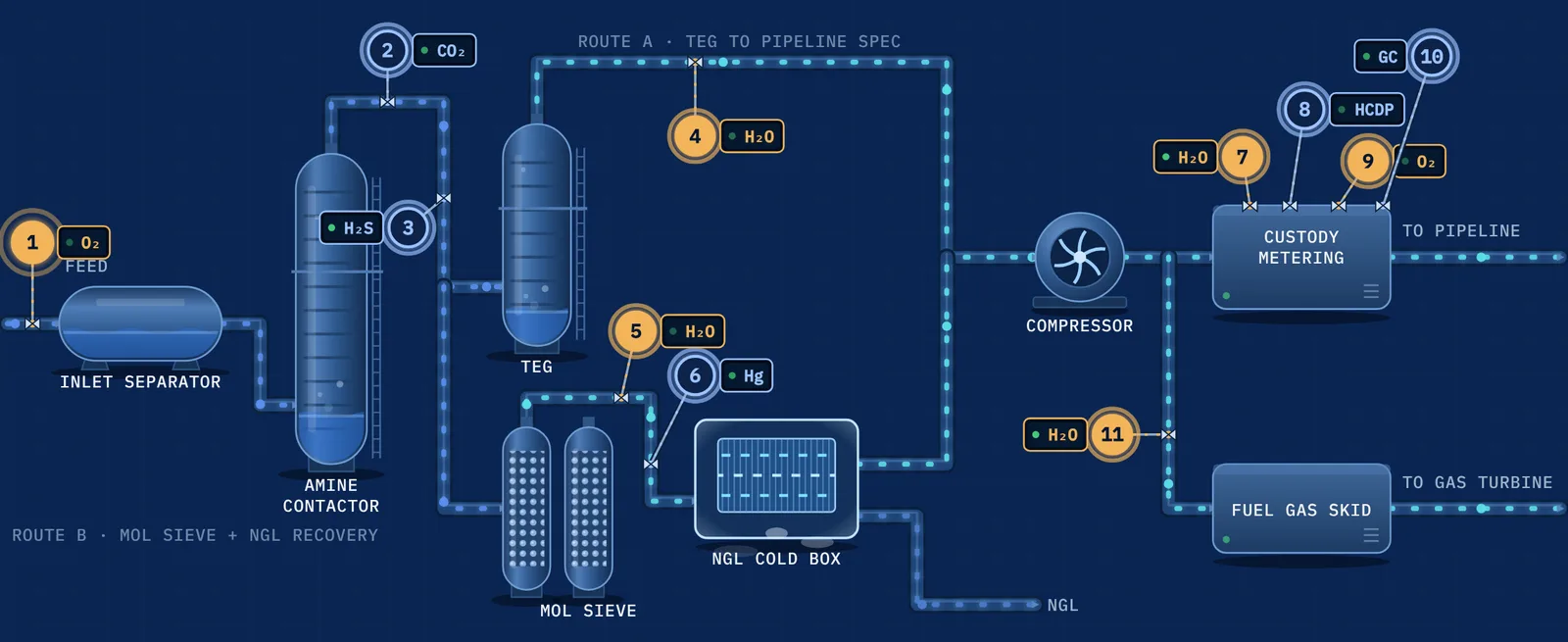
Which measurement for which job
| Task | Typical level | Instrument type | YORK option |
|---|---|---|---|
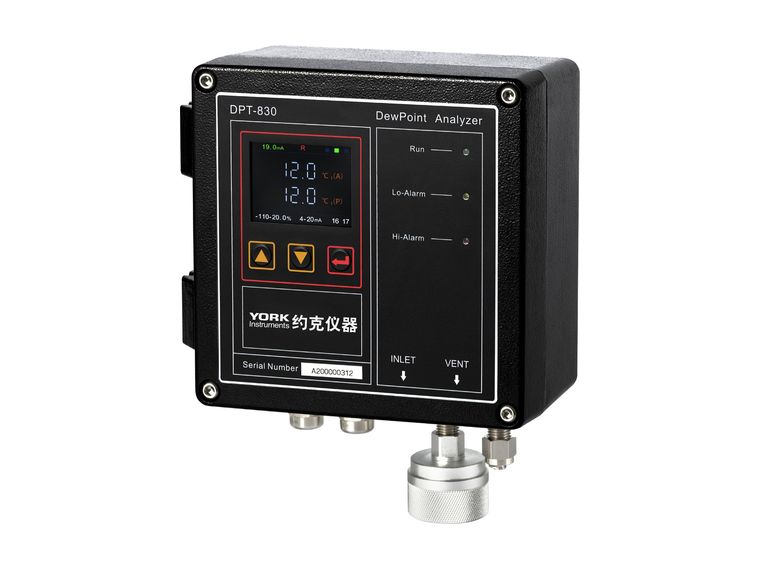
| Continuous water dew point after glycol or molecular sieve dehydration, and at export or custody points | Set by the pipeline or gas sales agreement | In-line dew point analyzer | DPT830 |
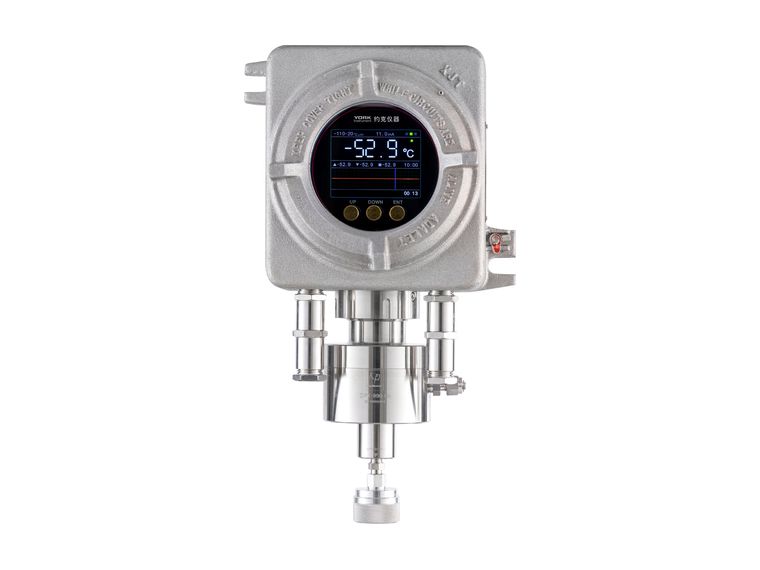
| In-line measurement where the analyzer itself must sit in the hazardous area | Same range as above | Explosion-proof dew point analyzer | DPT990-EX |
| Trace moisture at the molecular sieve outlet ahead of LNG liquefaction | Often around 0.1 ppmv (about −90 °C frost point) or drier | In-line dew point analyzer, range down to −110 °C frost point | DPT830 |
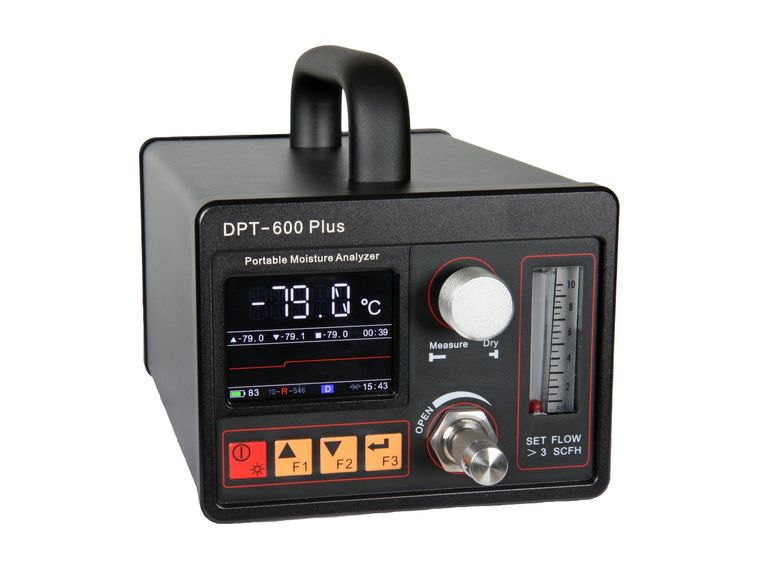
| Spot checks, troubleshooting and checking fixed analyzers | Same range as the fixed points | Portable dew point meter | DPT-600 Plus |
| Hydrocarbon dew point at export or custody points | Set by the pipeline or gas sales agreement | Hydrocarbon dew point analyzer | In development, coming soon |
Comparing technologies? See chilled mirror vs TDLAS vs metal-oxide.
Hydrocarbon dew point
The hydrocarbon dew point is the temperature at which heavier hydrocarbons start to condense from the gas at a given pressure. Gas specifications state it separately from the water dew point, because liquid dropout in the pipeline causes metering errors and two-phase flow.
Water dew point instruments do not measure hydrocarbon dew point; it needs its own analyzer. Sites measure it with an automatic hydrocarbon dew point analyzer, or calculate it from a process gas chromatograph analysis (ISO 23874).
A YORK hydrocarbon dew point analyzer is in development and is coming soon. If you have a requirement, contact us.
Dew point, ppmv and line pressure
Gas specifications give water as a dew point at a stated pressure, as ppmv, as mg/Sm³ or as lb/MMscf. YORK dew point instruments measure the gas after it has been reduced to near atmospheric pressure. The table converts an atmospheric-pressure reading to water content and to an approximate water dew point at 70 bar(a) (Sonntag 1990, ideal gas; mg/Sm³ at 15 °C and 1.01325 bar):
| Frost point at atmospheric pressure | Water content | mg/Sm³ | Water dew point at 70 bar(a), approx. |
|---|---|---|---|
| −30 °C | about 375 ppmv | about 286 | about +22 °C |
| −40 °C | about 127 ppmv | about 97 | about +5 °C |
| −50 °C | about 39 ppmv | about 30 | about −11 °C |
| −60 °C | about 11 ppmv | about 8.1 | about −26 °C |
| −70 °C | about 2.6 ppmv | about 2.0 | about −40 °C |
| −90 °C | about 0.1 ppmv | about 0.07 | — |
The same gas that reads −50 °C at atmospheric pressure has a water dew point of about −11 °C at 70 bar(a). This is why a reading and a specification must refer to the same pressure before they are compared. One lb/MMscf is about 21 ppmv. Real natural gas does not behave as an ideal gas at pipeline pressure, so for contract values use the correlation in ISO 18453 or our natural gas water content calculator; the instruments convert the measured dew point to line pressure with their built-in conversion function.
Where to measure
- Glycol contactor outlet: shows how well the TEG unit dries the gas. A rising dew point here usually points to glycol circulation, regeneration or contactor problems.
- Molecular sieve dryer outlet: ahead of LNG liquefaction or deep-cut units. The reading shows when a bed is approaching breakthrough and confirms that a regenerated bed is back in specification.
- Export and custody points: the measurement compared with the pipeline or gas sales agreement limit.
- Compressor stations and storage withdrawal: gas returning from storage or passing through compression can pick up water, so a dew point check here confirms the gas still meets the limit.
The natural gas processing map and the LNG pre-treatment map show these points on process diagrams.
For dehydration beds, see how to detect molecular sieve breakthrough.
Sampling and installation
- YORK dew point instruments accept sample pressure up to 4 barg. Take the sample through a pressure reducer and measure close to atmospheric pressure, then convert the result to line pressure.
- Gas cools as its pressure drops. Heat the pressure reducer and, where needed, the sample line, so that water or hydrocarbons do not condense before the sensor and give a false reading.
- Fit a filter ahead of the sensor where the gas may carry glycol, methanol or other liquids. The sensors measure gas only and must not see liquid.
- Use stainless steel tubing and leak-tight fittings, keep the line short and keep a steady flow. The sample line response time tool estimates the transport delay; at very low dew points, dry-down after the line has been opened can take hours.
- Route the vented sample to a safe location or to the site vent system, as the site procedure requires.
Questions we are asked
Our pipeline runs at 70 bar. How do you measure the dew point at line pressure?
YORK dew point instruments accept up to 4 barg, so the sample is reduced to near atmospheric pressure and measured there. The instrument then converts the reading to the dew point at line pressure. They do not compensate for pressure automatically; the line pressure is entered for the conversion.
What water dew point or water content limit applies to Gulf pipelines?
The limit is set by the gas sales agreement or the pipeline operator, and it differs between systems. When you ask for a quotation, send us the limit and the pressure it refers to, and we will propose a measurement range and sample system that fit it.
Can the analyzer be installed in a hazardous area?
The DPT990-EX is the explosion-proof in-line version, and the DPT-600 Plus portable meter can be ordered with an Ex-marked nameplate. Certificate details are sent with quotations. Where a project specifies IECEx or ATEX, ask us first; the analyzer can also be installed in a safe area with the sample line brought to it.
Suggested YORK instruments
- In-line monitoring at dryer outlets and custody pointsDPT830 →
- Hazardous-area installationsDPT990-EX →
- Spot checks and troubleshootingDPT-600 Plus →
- Hydrocarbon dew pointIn development, coming soon →
References
- ISO 6327:1981 Gas analysis — Determination of the water dew point of natural gas — Cooled surface condensation hygrometersInternational Organization for Standardization, 1981. The standard for measuring natural-gas water dew point with chilled-mirror (cooled-surface) hygrometers; confirmed as current in 2024.
- ISO 18453:2004 Natural gas — Correlation between water content and water dew pointInternational Organization for Standardization, 2004. Gives a method to convert between water content and water dew point in natural gas; confirmed as current in 2024.
- An investigation of the comparative performance of diverse humidity sensing techniques in natural gasJ. G. Gallegos, R. Benyon et al. (European metrology project team), Journal of Natural Gas Science and Engineering 23:407–416, 2015. Eleven hygrometers of different principles tested in natural gas at 0.1 to 6 MPa and 13 to 250 ppmv water; most performed well, while most aluminium-oxide probes drifted.
- Comparison of methods for the measurement of hydrocarbon dew point of natural gas (NPL Report AS 3)A. Brown, M. Milton et al., National Physical Laboratory (NPL), UK, 2007. Compares direct chilled-mirror instruments with gas-chromatography calculations on synthetic and real gases; concludes that reported hydrocarbon dew points should state the method used.
- ISO/TR 12148:2009 Natural gas — Calibration of chilled mirror type instruments for hydrocarbon dewpoint (liquid formation)International Organization for Standardization, 2009. Requirements for traceable calibration of automated chilled-mirror hydrocarbon dew point instruments; confirmed as current in 2024.
- ISO 23874:2006 Natural gas — Gas chromatographic requirements for hydrocarbon dewpoint calculationInternational Organization for Standardization, 2006. Sets the gas-chromatograph performance (C5 to C12) needed to calculate pipeline-gas hydrocarbon dew point with an equation of state.
- ISO 13686:2013 Natural gas — Quality designationInternational Organization for Standardization, 2013. Defines the parameters used to describe the quality of processed natural gas; confirmed as current in 2025.
External sources open on the publisher's website. YORK Instrument is not affiliated with them. All measurement references →
Where exactly are the points? See the animated natural gas measurement-point map.
Supplying an LNG train? See the animated LNG measurement-point map.
Storing, compressing or injecting gas? See the animated storage, CNG and biomethane map.
Discuss your application
Tell us the gas, pressure, sample point and the limit you need to meet, and we will propose instruments and a sample system.