 MIDDLE EAST
- Home
- Applications
- Petrochemical & refining
Application
Petrochemical and refining process gases
Trace moisture at dryer outlets and in hydrocarbon process gases, and oxygen in purge and blanketing nitrogen, for petrochemical plants and refineries.
Why it matters
Moisture in hydrocarbon process gases can poison catalysts, cause corrosion and form hydrates or ice in cold sections. Molecular sieve and other dryers are monitored at the outlet to confirm performance and to time regeneration.
Nitrogen used for purging and blanketing is checked for oxygen content, often in hazardous areas where explosion-proof analyzers are required.
Which measurement for which job
| Task | Typical level | Instrument type | YORK option |
|---|---|---|---|
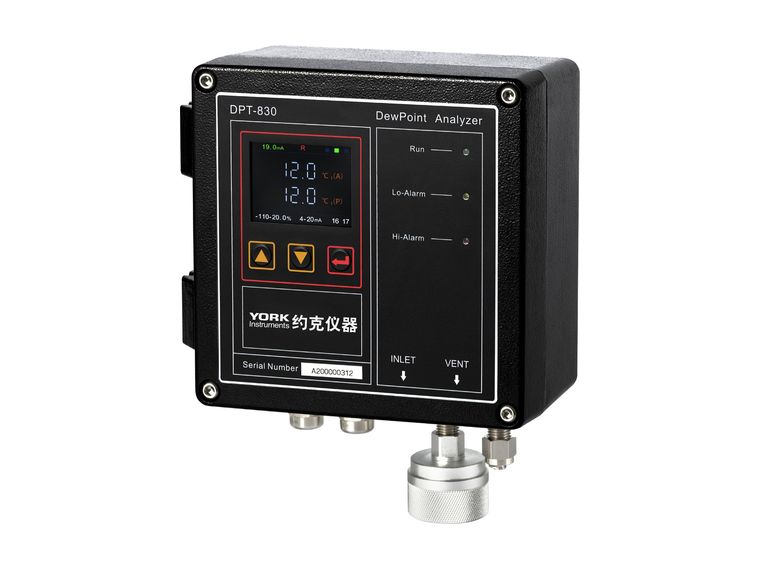
| Moisture at molecular sieve or alumina dryer outlets on feed, hydrogen, olefin and cracked gas streams | Set by the unit design or licensor, usually in low ppmv | In-line dew point analyzer, range down to −110 °C frost point | DPT830 |
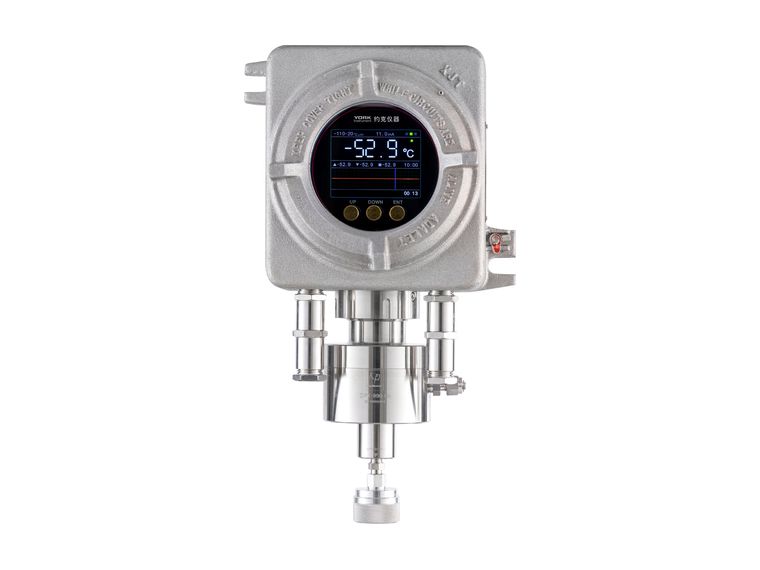
| In-line moisture where the analyzer itself must sit in the hazardous area | Same range as above | Explosion-proof dew point analyzer | DPT990-EX |
| Moisture in catalytic reformer recycle gas (hydrogen containing HCl) | Refiners report about 15 to 35 ppm, with a target near 20 ppmv | Integrated laser moisture system; a chilled mirror is not suitable | Analyzer systems |
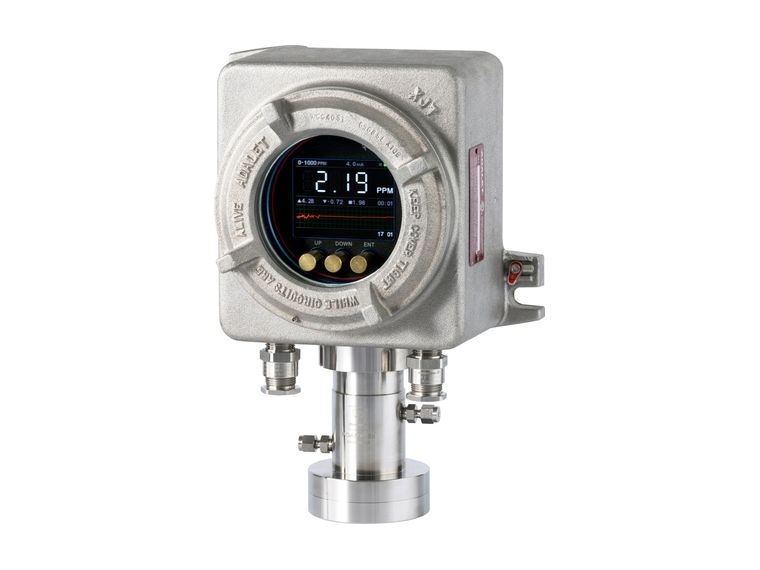
| Oxygen in purge and blanketing nitrogen in hazardous areas | Set by the site purge or blanketing procedure | Explosion-proof oxygen analyzer, 0.01 ppm to 25 % O₂ | PGA500-EX |
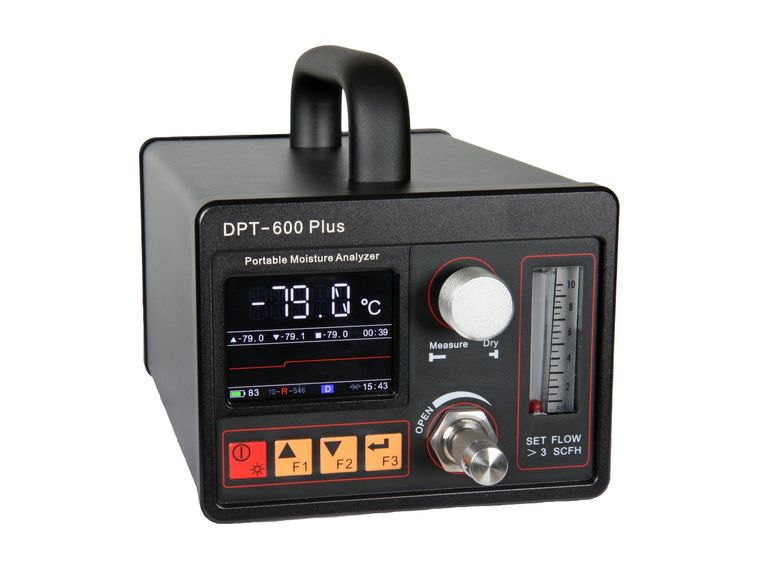
| Spot checks, troubleshooting and checking fixed analyzers | Same range as the fixed points | Portable dew point meter | DPT-600 Plus |
ppmv, frost point and process pressure
Licensors and operating manuals give moisture limits in ppmv, while dew point instruments read a frost point. YORK dew point instruments measure the gas after it has been reduced to near atmospheric pressure, so the same gas reads colder at the instrument than it would at process pressure. The table converts water content to frost point at atmospheric pressure and at 30 bar(a) (Sonntag 1990, ideal gas):
| Water content | Frost point at atmospheric pressure | Frost point at 30 bar(a), approx. |
|---|---|---|
| 1 ppmv | about −76 °C | about −52 °C |
| 5 ppmv | about −66 °C | about −39 °C |
| 10 ppmv | about −61 °C | about −32 °C |
| 20 ppmv | about −55 °C | about −26 °C |
| 35 ppmv | about −51 °C | about −20 °C |
| 100 ppmv | about −42 °C | about −8 °C |
| 500 ppmv | about −27 °C | about +13 °C (dew point) |
A recycle gas at 20 ppmv therefore reads about −55 °C at atmospheric pressure but forms ice at about −26 °C at 30 bar(a). For cold sections, compare the frost point at the actual pressure and temperature of the coldest exchanger with the reading. The instruments convert the measured dew point to line pressure with their built-in conversion function; hydrocarbon gases at high pressure are not ideal, so treat the table as a guide.
Where to measure
- Dryer outlets: a rising reading shows that a bed is approaching breakthrough, and a reading after regeneration confirms the bed is back in specification before it goes on line.
- Ahead of cold sections: before cryogenic or chilled units, where water would freeze or form hydrates and block exchangers.
- Reformer recycle gas: water and chloride in the recycle gas set the activity of the reforming catalyst, so moisture is trended continuously.
- Nitrogen headers for purging and blanketing: oxygen is checked before equipment is opened or returned to service, and on tank blanketing supplies.
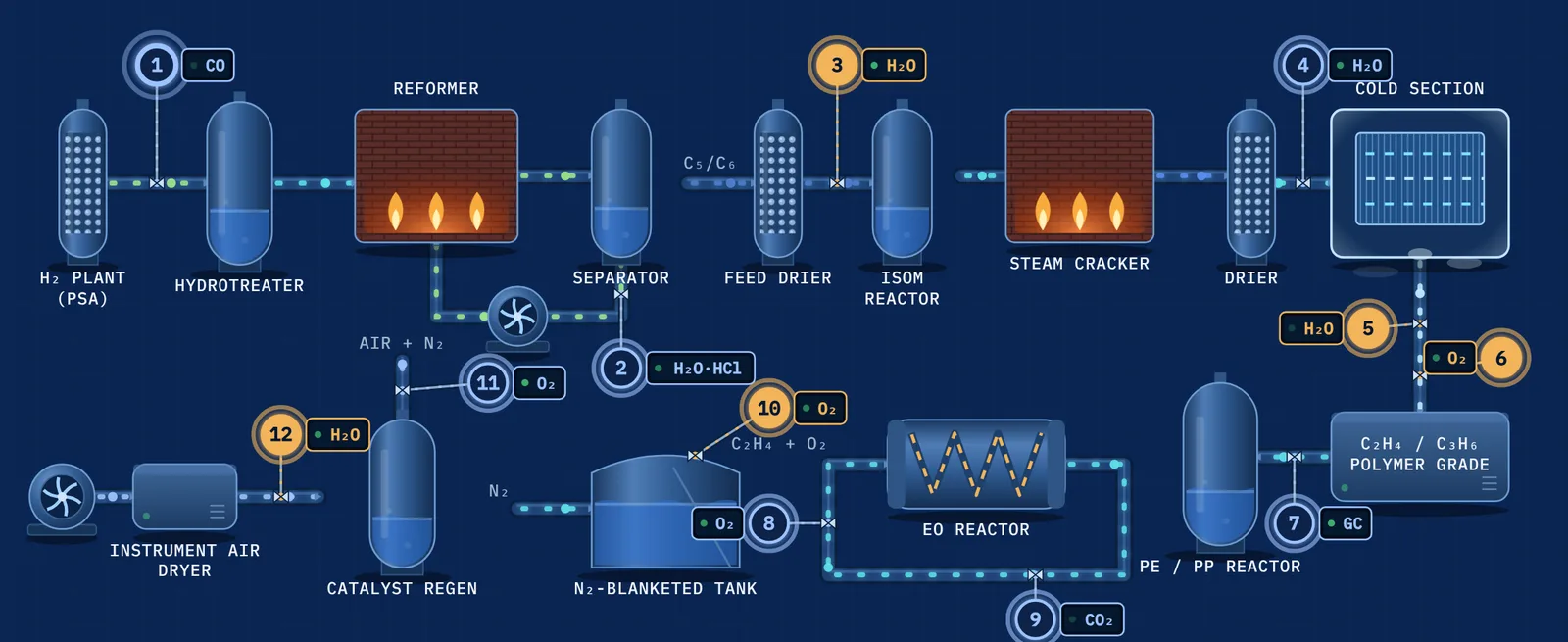
The refinery and petrochemical map and the GTL and methanol map show these points on process diagrams.
Sampling and installation
- YORK dew point instruments accept sample pressure up to 4 barg. Take the sample through a pressure reducer and measure close to atmospheric pressure, then convert the result to process pressure.
- Heat the pressure reducer and, where needed, the sample line, so that heavy hydrocarbons or water do not condense before the sensor.
- Fit a filter ahead of the sensor where the gas may carry liquids. The sensors measure gas only.
- Electrochemical oxygen sensors work in hydrogen and hydrocarbon backgrounds, but their life is shorter, about 12 months, so plan regular sensor replacement. They are not used in gases containing H₂S, HCl, SO₂ or CO₂.
- Use stainless steel tubing, keep the line short and the flow steady, and route the vented sample to the flare or another safe location as the site procedure requires. The sample line response time tool estimates the transport delay.
Questions we are asked
Can a chilled mirror measure moisture in reformer recycle hydrogen?
No. Recycle gas from a catalytic reformer contains HCl, and a chilled mirror is not suitable for it. For this point we propose an integrated laser moisture system. Send us the gas composition, pressure and the moisture range, and we will evaluate it.
How long does an electrochemical oxygen sensor last in hydrogen or hydrocarbon gas?
About 12 months, which is shorter than in nitrogen or argon, so the sensor should be replaced on a schedule. Electrochemical sensors are not used where the gas contains H₂S, HCl, SO₂ or CO₂. For gases containing CO₂ we use the paramagnetic POA3500, installed in a safe area.
Can the analyzers be installed in a hazardous area?
The DPT990-EX dew point analyzer and the PGA500-EX oxygen analyzer are the explosion-proof in-line versions, and the DPT-600 Plus portable meter can be ordered with an Ex-marked nameplate. Certificate details are sent with quotations. Where a project specifies IECEx or ATEX, ask us first; the analyzer can also be installed in a safe area with the sample line brought to it.
Suggested YORK instruments
- GTL and methanol measurement pointsMap →
- Dryer outlet moisture, in-lineDPT830 →
- Hazardous-area moistureDPT990-EX →
- Hazardous-area trace oxygenPGA500-EX →
- Spot checksDPT-600 Plus →
References
- Petroleum Refining Process (OSHA Technical Manual, Section IV, Chapter 2)US Occupational Safety and Health Administration. Overview of the main refinery units (distillation, cracking, alkylation, catalytic reforming, hydrotreating) where process gases are sampled and analysed.
- What is the importance of water content in reformer feed and recycle gas on the performance of the catalyst? (Q&A)American Fuel & Petrochemical Manufacturers (AFPM), technical Q&A, 2017. Refining practitioners explain why water in catalytic-reformer feed and recycle gas must be measured and controlled, with target levels in ppm.
- Operating parameters, including water or chloride additions, on a CCR reforming unit (Q&A)American Fuel & Petrochemical Manufacturers (AFPM), technical Q&A, 2011. Refiners report recycle-gas moisture of about 15 to 35 ppm and a target near 20 ppmv to keep the water–chloride balance of the reforming catalyst.
- Moving Forward as On-Line Analyzers Improve (paper 24e)AIChE Spring Meeting & Global Congress on Process Safety, 2014. How online analyzers for hydrogen, moisture and combustion improve control and product consistency in refining.
External sources open on the publisher's website. YORK Instrument is not affiliated with them. All measurement references →
Where exactly are the points? See the animated refinery and petrochemical measurement-point map.
Sulfur recovery and flare analyzers? See the animated sulfur recovery and flare map.
Discuss your application
Tell us the gas, pressure, sample point and the limit you need to meet, and we will propose instruments and a sample system.