 MIDDLE EAST
- Home
- Applications
- Pipeline drying and purging
Application
Pipeline pre-commissioning: drying and nitrogen purging
Confirming that a pipeline or plant piping is dry after hydrotest, and that the nitrogen purge has reached its oxygen target before gas-in, with YORK portable dew point meters and oxygen analyzers.
Why it matters
Water left in a line after hydrostatic testing forms hydrates with natural gas, drives corrosion together with CO₂ and H₂S, and contaminates dry products such as sales gas, LNG feed, nitrogen and instrument air. Lines are therefore swabbed with foam pigs and dried with dry air, vacuum or nitrogen before they go into service.
The line is accepted when the gas leaving the receiving end reaches the dew point given in the project drying procedure and stays there through a soak test. Before hydrocarbons are introduced, a nitrogen purge then brings the oxygen down to the target in the purging procedure. Both end points are confirmed by measurement, not by calculation alone.
What a drying dew point means
Drying is usually checked on gas vented at the receiving end, close to atmospheric pressure. For reference, the water content at atmospheric pressure is:
| Dew point / frost point at 1 atm | Water content |
|---|---|
| −20 °C | 1,019 ppmV (819 mg/Nm³) |
| −30 °C | 375 ppmV (301 mg/Nm³) |
| −40 °C | 127 ppmV (102 mg/Nm³) |
| −60 °C | 10.7 ppmV (8.57 mg/Nm³) |
The acceptance value always comes from the project drying procedure. If you measure at pressure, convert the reading with the dew point calculator before comparing it with the limit; more values are in the dew point to ppm table.
Where to measure
| # | Point | What is checked | Typical requirement | YORK instrument |
|---|---|---|---|---|
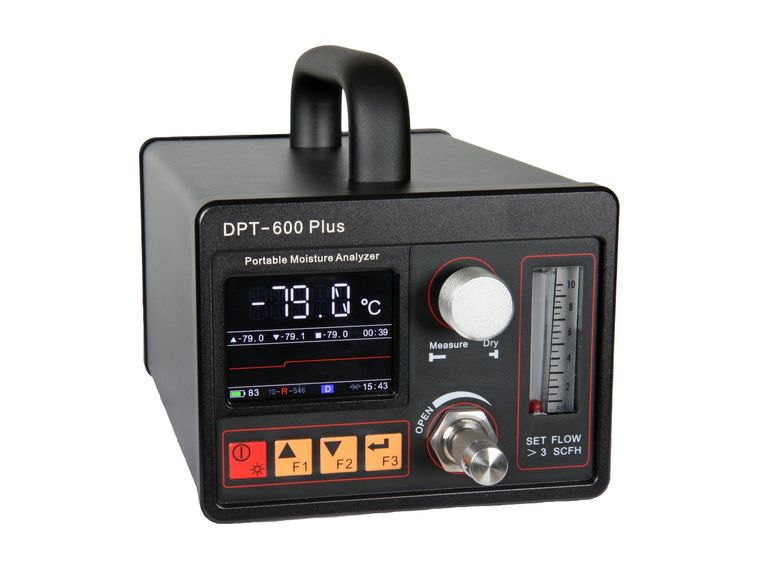
| 1 | Drying air or nitrogen supply | Dew point of the drying medium | Clearly drier than the acceptance value | DPT-600 Plus, DPT830 |
| 2 | Receiving end, during drying | Outlet dew point trend | Falls towards the acceptance value | DPT-600 Plus |
| 3 | Receiving end, soak test | Dew point after the line has been closed for the specified period | No significant rise above the acceptance value | DPT-600 Plus; DM9600P as a reference |
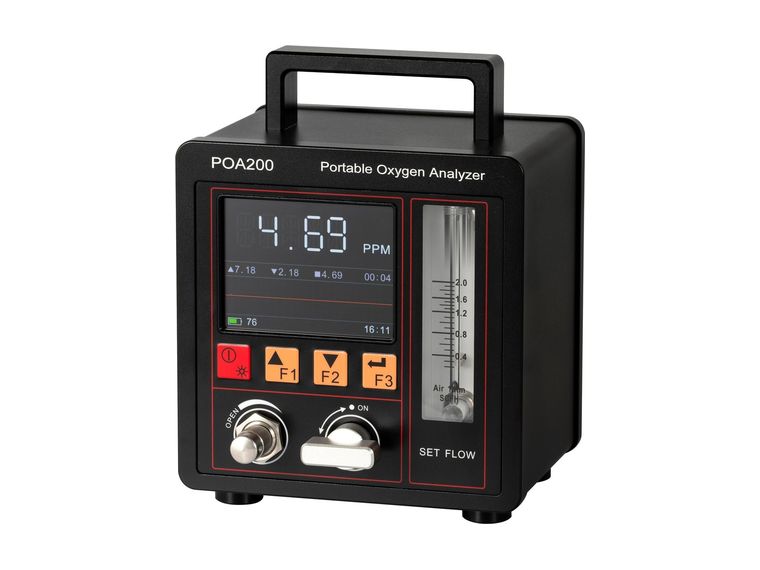
| 4 | Nitrogen supply | Oxygen and dew point of the nitrogen itself | A line cannot be purged below the oxygen content of the purge gas | POA200, DPT-600 Plus |
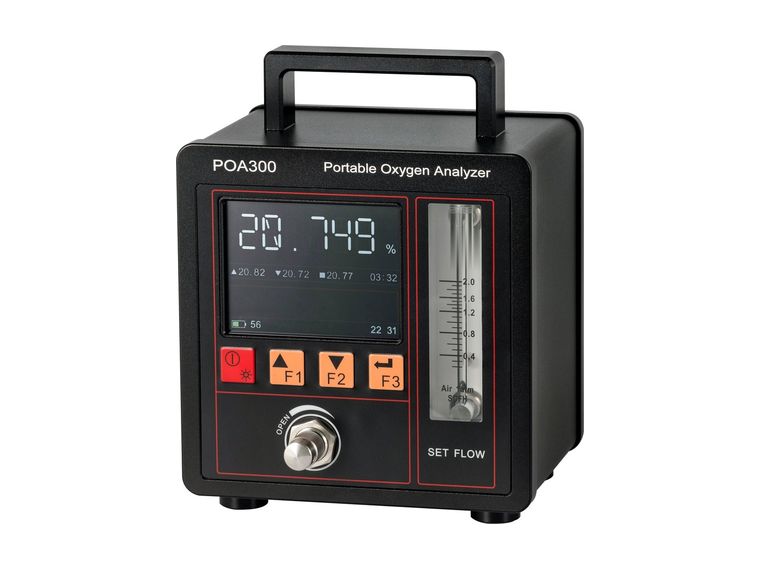
| 5 | Far end and vents, during the nitrogen purge | Oxygen (% or ppm) | The target in the purging procedure | POA300 (percent), POA200 (ppm) |
| 6 | Hazardous-area points at gas-in | Oxygen and dew point online | Per the commissioning procedure | PGA500-EX, DPT990-EX |
How much nitrogen a purge needs
A worked example from the nitrogen purge calculator: a 10 km, 12-inch line (0.30 m bore) holds about 707 m³, or about 670 Nm³. At 1,000 Nm³/h the gas moves at about 4 m/s, in turbulent flow, so the nitrogen pushes the air out with little mixing. With a margin of 1.5 for branches, dead legs and valve cavities, plan about 1,000 Nm³ of nitrogen and about one hour, then confirm the end point with an oxygen analyzer at the far end.
Taking reliable readings
- Measure at the receiving end and at low points or branches named in the procedure, not only at the injection end.
- Use short stainless steel sample lines. Plastic tubing gives off moisture and slows low dew point readings.
- YORK dew point instruments accept up to 4 barg. Reduce the pressure, measure, and report the dew point at the stated pressure.
- Allow time to settle: a reading at −40 °C takes much longer than one at −20 °C.
- Purge the oxygen analyzer sample line and check the reading in air (20.9 % O₂) before the job.
- Log time, location, pressure and reading for the pre-commissioning dossier.
Questions we are asked
What dew point is needed to accept a dried pipeline?
The project drying procedure sets it. As a reference, −20 °C at atmospheric pressure is about 1,019 ppmV of water and −40 °C is about 127 ppmV. Measure at the receiving end, then repeat after the soak test.
What is a soak test in pipeline drying?
After the outlet reaches the acceptance dew point, the line is closed for the period given in the procedure and the dew point is measured again. A clear rise shows water still trapped in the line, and drying continues.
How much nitrogen does a pipeline purge need?
Slightly more than one pipe volume in a straight line in turbulent flow, plus a margin of 1.5 to 3 for branches and dead legs. A 10 km, 12-inch line needs about 1,000 Nm³, about one hour at 1,000 Nm³/h. The nitrogen purge calculator works this out for your line.
Which YORK instruments are used for pipeline pre-commissioning?
The DPT-600 Plus portable dew point meter, from −110 °C frost point to +20 °C dew point, for drying checks; the POA300 (0 to 100 % O₂) or POA200 (0.01 ppm to 25 % O₂) portable oxygen analyzers for the nitrogen purge end point. For online points in hazardous areas, the explosion-proof DPT990-EX and PGA500-EX.
Suggested YORK instruments
- Drying checks and soak testsDPT-600 Plus →
- Nitrogen purge end point, percent O₂POA300 →
- Nitrogen purity and ppm O₂ targetsPOA200 →
- Online points in hazardous areasDPT990-EX →
Planning the purge? Use the nitrogen purge calculator for nitrogen volume, flow, time and cost.
Drying gas lines? See natural gas water dew point and oxygen monitoring for inerting.
Commissioning a pipeline?
Tell us the line size and length, the drying method, the acceptance dew point and the oxygen target, and we will propose portable instruments for the job.